Managing hardware for a large detector is as much an information problem as it is an engineering one.
Over the past weeks I built a web application to manage the CMS Tracker backend assets and their topology, with the goal of creating a single operational view of devices, connections, and status.
This post explains what the project is, how it’s structured, and why one feature — a natural-language query interface powered by an LLM — turned out to be surprisingly useful.
The problem: fragmented operational knowledge
Backend hardware ecosystems evolve organically. Boards move between crates, optical links get re-patched, firmware changes, and components are replaced.
The information exists — but often across spreadsheets, ad-hoc notes, and multiple small tools. The result is friction:
- It’s hard to answer simple operational questions quickly
- Inconsistencies creep in
- The cognitive load for shifters and experts grows
The goal of this project was to create a single source of truth that is:
- Structured and consistent
- Easy to update safely
- Immediately useful for day-to-day operations
What the application does
At its core, the app is an asset and topology manager for CMS Tracker backend hardware. It provides:
- Inventory of ATCA assets (boards, crates, racks, slots, power)
- Tracking of linked components (SOMs, IPMCs, FireFly modules, fibres)
- Role-based access control (reader, writer, admin)
- Automatic propagation of status and location when hardware is installed or moved
- A normalized relational data model to keep updates consistent
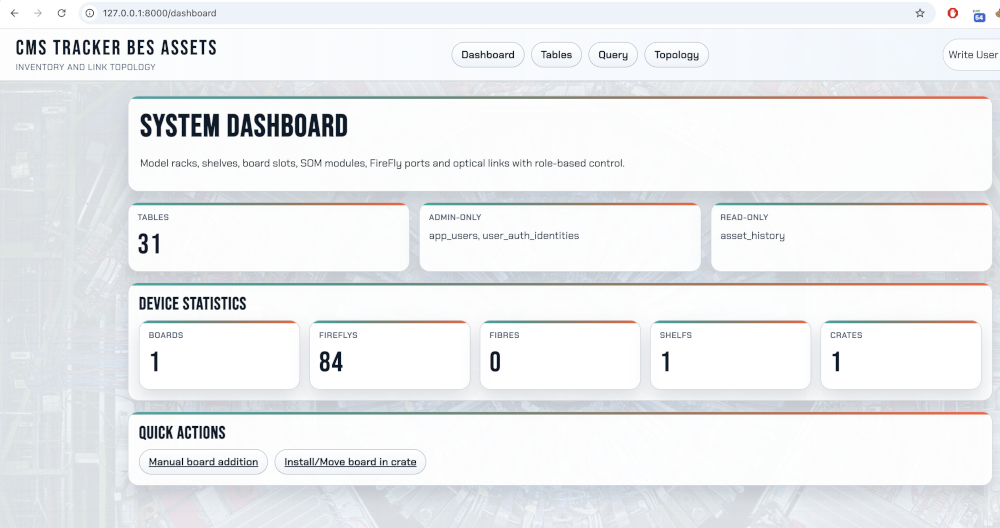
The emphasis was not only on storing data, but on making operational workflows explicit — for example, installing a board updates multiple related entities automatically, reducing manual bookkeeping.
Architecture in a nutshell
The stack is intentionally simple and pragmatic:
- Backend: FastAPI
- Database: PostgreSQL with a normalized schema
- ORM layer: SQLAlchemy Core with reflection
- Auth: role-based with future CERN SSO integration
- UI: server-rendered templates focused on clarity over complexity
The app works directly on an existing schema, so it can evolve with the hardware model without heavy refactoring.
The interesting part: natural-language queries → SQL
One feature I wanted to experiment with was lowering the barrier to querying the database.
Operational questions are often phrased in plain language:
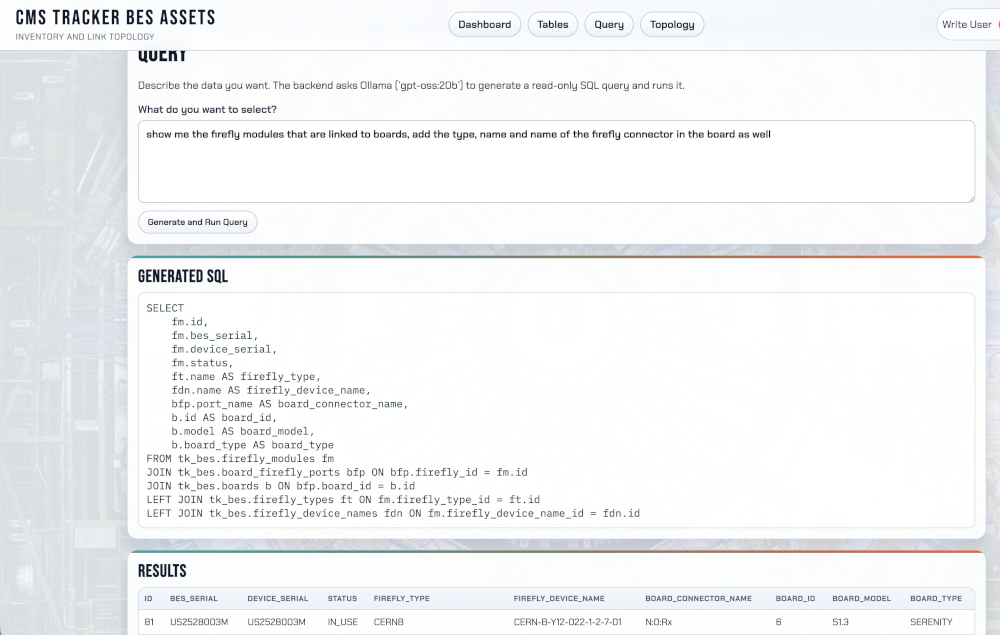
“Show me the FireFly modules connected to boards, including type and connector.”
Instead of requiring users to write SQL, the app includes a Query page where you describe the data you want.
The backend then:
- Uses an LLM to generate a read-only SQL query
- Validates and executes it
- Displays both the query and the results
Why this is useful in practice
This feature isn’t about replacing SQL — it’s about speed and accessibility.
1. Faster operational checks
You can ask ad-hoc questions without remembering table structures.
2. Transparency and trust
Showing the generated SQL makes the process auditable and educational.
3. A bridge between mental and data models
People think in terms of devices and links, not joins — the interface translates between the two.
4. Safe by design
Queries are generated as read-only, preventing accidental modifications.
Lessons learned
Modeling matters more than UI
A clean schema with explicit relationships made everything else easier — including LLM prompting.
LLMs work best with constraints
Providing schema context and enforcing read-only execution keeps outputs reliable.
Small operational tools have big impact
Even simple visibility improvements reduce friction in daily work.
What I’d like to explore next
- Graph visualization of topology
- Query history and saved operational views
- Tighter integration with authentication (SSO)
- Automated consistency checks across links
Final thoughts
This project sits at the intersection of detector operations, software engineering, and human-computer interaction.
The most rewarding aspect is that it’s immediately useful: a tool built not as a demo, but as part of the operational workflow.
And the LLM query interface is a small glimpse of how interacting with complex technical systems might become more conversational — while still grounded in precise, auditable data.
Leave a Reply